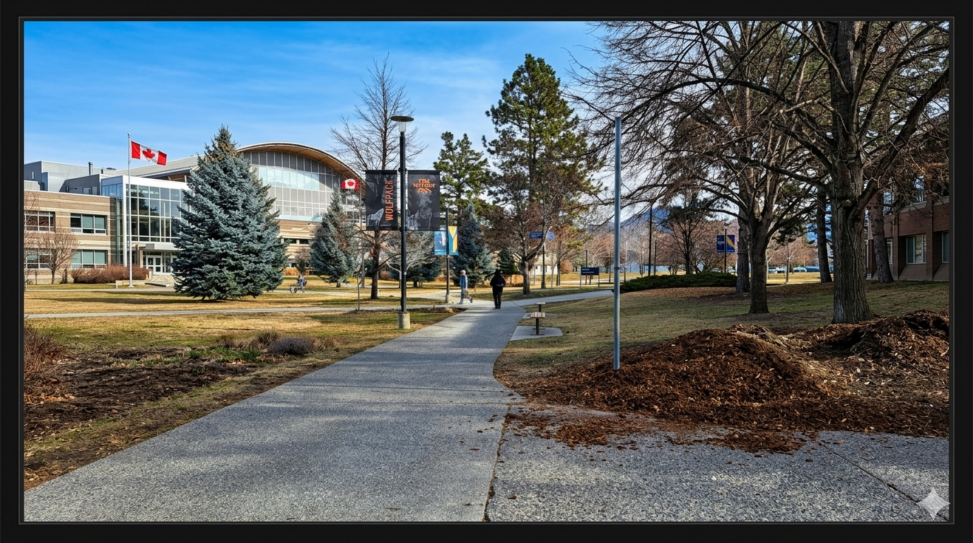
Why did you choose this place?
I chose this place because, in the beginning, it felt completely ordinary to me. It was just a path I used every day without thinking. But that is exactly why I picked it.
I wanted to challenge myself to see if something so routine and unnoticed could actually become meaningful. Over time, this place became more than just a walkway. It became something familiar, something I started to recognize and connect with, simply because I chose to pay attention.
What have you enjoyed about connecting with it?
What I enjoyed the most is how this experience changed my perspective. At first, I would just walk through this place without noticing anything, but as the weeks went on, I started seeing details I had completely ignored before — the movement of people, the trees, the WolfPack banners, and even the Canadian flag in the distance. It made me realize that places are not just physical locations, they are experiences shaped by how present we are. That shift in awareness is something I genuinely enjoyed.
Which course concept did you connect with and how?
The concept I connected with the most is vernacular landscapes. This pathway is not designed to be special, but it reflects everyday life on campus — routines, habits, and shared experiences. It shows how people naturally use and shape space through their daily actions. This helped me understand that meaning is not always created by design, but by repetition and human interaction. Even a simple path can carry identity and meaning because of the people who use it.
One thing you are grateful for about your place
One thing I am truly grateful for is the sense of consistency this place provides. No matter how my day is going, this path remains the same. It gives me a moment to pause, reset, and move forward. I didn’t realize how important that was until I started paying attention. Sometimes, it is the simplest places that support us the most without us even noticing.
One reason your place might feel grateful for you
If I think about it from the place’s perspective, I believe it might feel grateful that I have started to truly see it. I no longer treat it as something invisible or automatic. Instead, I move through it with awareness, respect, and appreciation. In a small way, by being more mindful, I contribute to the space instead of just using it.
Because in the end, like Ralph Waldo Emerson said, “The only person you are destined to become is the person you decide to be.” For me, this experience was not just about a place, but about becoming someone who notices, values, and connects.
References
- Westland, R. (2026). Interpreting places and landscapes [Lecture slides]. Thompson Rivers University.
- Knox, P. L., Marston, S. A., & Imort, M. (2019). Human geography: Places and regions in global context (5th Canadian ed.). Pearson.